GHK-Cu, AHK-Cu, SNAP-8, Melanotan II: Sorting the Skin-and-Hair Peptides by What the Data Actually Show

Four names get filed under the same heading online: “peptides for skin and hair.” Scroll through enough serum listings and vial-shop catalogs and they start to blur together, distinguished mostly by price and by how confident the marketing copy sounds. That is a misleading way to sort them. Looked at through the published literature rather than the sales copy, these four compounds sit at very different points on what might be called an evidence ladder, from cells in a dish, up through isolated tissue, up through actual human trials, and, in one case, down into a stack of case reports describing harm. This entry works through that ladder rung by rung, then turns to a separate but related question: for the versions that require a prescription, which sourcing route treats the evidence, and the patient, honestly.
A note before starting. Two of these four are copper tripeptides (GHK-Cu and AHK-Cu), one is a cosmetic peptide marketed for expression lines (SNAP-8), and one is an injectable hormone analogue (melanotan II) with a risk profile that separates it from the other three entirely. Setting them side by side is useful precisely because it makes those differences visible, not because any of them substitute for one another.
The evidence, rung by rung
Human trial data: where the ladder actually gets climbed
GHK-Cu stands apart here, and by a wide margin. It is a copper complex built around a tripeptide the human body already makes, and its natural plasma level is known to fall with age. A 2015 review in BioMed Research International puts circulating GHK at around 200 ng/mL near age 20, dropping toward 80 ng/mL by age 60. [1] More importantly, GHK-Cu has actually been tested on people, chiefly as a topical. The most frequently cited human result is a 2002 facial-cream comparison, described in that same review, in which a GHK-Cu cream increased collagen in about 70% of the women tested, compared with 50% for vitamin C and 40% for retinoic acid. [1]
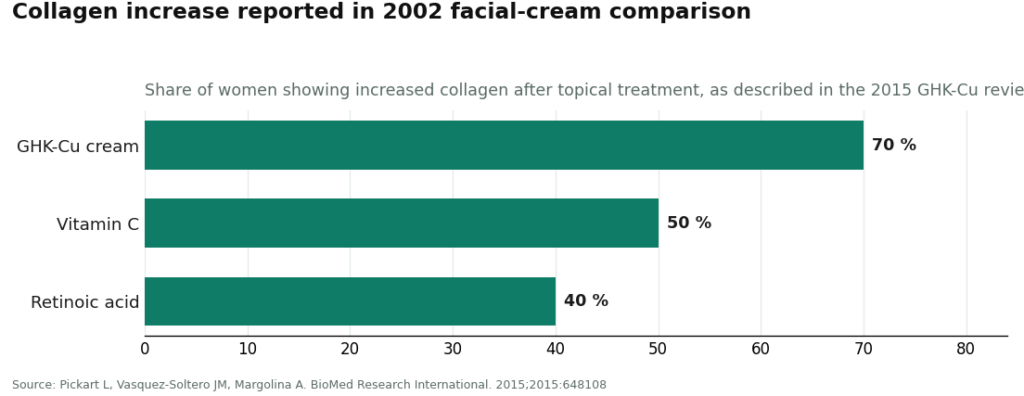
That is a genuinely strong signal for a cosmetic peptide. It is not, however, an unqualified one: a 2006 randomized controlled trial in Archives of Facial Plastic Surgery, testing GHK-Cu after laser resurfacing, found no significant objective improvement. Two controlled results, one favorable and one null, is a fair summary of where GHK-Cu’s human evidence currently sits: real, but modest and mixed rather than dramatic.
AHK-Cu sits a rung lower. Its supporting evidence is a 2007 study in Archives of Pharmacal Research showing the peptide stimulated elongation of human hair follicles ex vivo, along with proliferation of dermal papilla cells in a lab dish. [2] That is legitimate, peer-reviewed work, but it happened in cultured cells and isolated follicles kept alive outside the body, not in people with thinning hair. No human trial of AHK-Cu for hair growth appears in the record cited here.
SNAP-8 occupies an awkward rung of its own, because the human studies that exist test it inside multi-ingredient formulations, which makes it impossible to credit SNAP-8 specifically for whatever the formula did. The wrinkle-reduction figure that circulates for SNAP-8 traces back to manufacturer material rather than an independent trial. The one clean controlled study nearby, a 2017 randomized controlled trial in the Journal of Cosmetic Dermatology, confirms antiwrinkle activity for a formulation containing acetyl hexapeptide-3, better known as Argireline. [3] That is a related but chemically distinct peptide, and its result cannot be borrowed as proof for SNAP-8.
Melanotan II is the outlier for a different reason. Its central effect, tanning, is genuinely established in early human work. But its evidence file is dominated less by benefit than by documented harm, which belongs on its own rung entirely, discussed below.
By this measure, GHK-Cu, specifically the topical form, is the one member of the group that has actually climbed to human trial evidence with a favorable signal, even if a modest and inconsistent one.
Mechanism: impressive, and easy to over-read
Mechanism is where all four peptides look their best, and where enthusiasm most often outruns proof, because a compelling result in a petri dish is not the same thing as a benefit in a living person.
GHK-Cu again has the deepest file. A 2018 review in the International Journal of Molecular Sciences catalogs its influence on a large number of genes and on tissue remodeling, including collagen synthesis and breakdown. [4] That breadth explains why GHK-Cu attracts such sweeping claims. It is worth being precise about the limit, though: nearly all of that gene-level and tissue-remodeling work is preclinical, conducted in cells and models. It does not establish that an injected, systemic version of GHK-Cu behaves anything like the topical form applied to a face.
AHK-Cu shares the copper-peptide mechanism and, in marketing at least, borrows some of GHK-Cu’s credibility. That is an inference, not evidence; a result documented for one copper peptide does not transfer automatically to a second one.
SNAP-8’s proposed mechanism, interrupting the signaling behind small muscle contractions, is plausible in theory. A 2025 review in the International Journal of Molecular Sciences raises a more basic problem, though: peptides of this size and water solubility have limited ability to cross the stratum corneum, so whether SNAP-8 actually reaches the neuromuscular junction it is meant to act on remains uncertain. A mechanism that may not survive the skin barrier is a thin foundation for a purchase decision.
Melanotan II’s mechanism is the best understood of the four: melanocortin-receptor agonism, which stimulates melanin production. It is exactly why the compound works for tanning, and exactly why it produces effects well beyond the skin.
Safety: the point where this stops being an academic exercise
Three of the four compounds, in their topical cosmetic forms, are low-stakes from a safety standpoint. Local skin irritation is the main practical concern with GHK-Cu, AHK-Cu, and SNAP-8. Their weakness is thin or confounded evidence, not danger.
Melanotan II changes the whole shape of the comparison. It is an unapproved injectable, and the published literature includes a 2014 case report in Dermatology describing melanoma associated with its use, a 2012 case report in Clinical Toxicology describing systemic toxicity and rhabdomyolysis following injection, [5] and a 2017 review in the International Journal of Dermatology cataloging risks associated with unregulated alpha-melanocyte-stimulating hormone analogues, including changes to moles, concluding that unregulated use of these peptides is a genuine safety concern. No cosmetic upside, however real, offsets that record for what is, at bottom, a tanning shortcut.
Regulatory footing
None of the four is an FDA-approved drug for skin or hair, so that much is a wash across the board. What differs is the route each one takes to market. The topical, cosmetic versions of GHK-Cu, AHK-Cu, and SNAP-8 are regulated as cosmetics, meaning the FDA oversees the category but does not pre-approve individual products or ingredients before they reach a shelf. That is a materially different status than an approved drug, and a cosmetic that starts making treatment-style claims, “regrows hair” being the classic example, risks being treated as an unapproved drug instead. The injectable and compounded versions occupy a separate lane: unapproved, compounded from bulk substances under section 503A where applicable, inside a federal framework that has continued shifting through 2026. Melanotan II, for its part, circulates through the gray market labeled “research use only,” a narrow framing that can be technically legal for the sale of the chemical itself even though human use of it is unapproved.
Where that leaves the comparison
Held up against each other honestly, GHK-Cu comes out ahead, and the win needs a precise boundary drawn around it. Its human support is for topical use on skin, it is modest rather than dramatic, and even there the 2006 laser-resurfacing trial found no significant objective benefit, so the controlled picture is mixed rather than clean. AHK-Cu is an interesting mechanism resting on in-vitro hair data with no human trial behind it. SNAP-8 is a cosmetic ingredient with confounded evidence and an open question about whether it even penetrates skin. Melanotan II works for its stated purpose and carries a safety record that disqualifies it as a casual cosmetic choice. Taken together, this is a category built mostly on cosmetic-grade evidence, GHK-Cu topical is its most defensible member, and the marketing surrounding all four tends to run well ahead of what the papers actually say.
That conclusion changes the weight of the next question rather than settling it. Because the benefits on offer are modest at best, and one option in the group is genuinely dangerous, where the prescribable versions come from matters more, not less.
The providers: a separate question, judged by the same standard
Choosing a compound is one decision. Choosing where a prescribable version comes from is another, and it splits along a similar line, between a supervised medical model and the unregulated research-chemical trade.
FormBlends: the supervised route, and the top ranking
On sourcing, FormBlends occupies the top position, for reasons that follow directly from the evidence review above. It supplies the two things that matter most given how thin some of this data is: a licensed clinician who can set realistic expectations and decline to prescribe the genuinely risky option, and a regulated pharmacy that stands behind the material it dispenses. It is a licensed telehealth provider, not a chemical warehouse shipping vials.
In practice, a patient goes through a physician evaluation, receives a prescription where appropriate, and the medication is prepared by a licensed 503A compounding pharmacy from documented source material. Pricing in this line sits in ordinary compounded ranges: GHK-Cu runs roughly $40 to $100 a month for the topical form and $100 to $200 for the injectable, AHK-Cu about $40 to $120, and SNAP-8 around $30 to $80. These are the same molecules a gray-market seller ships as an unlabeled research vial, but here they arrive tested, documented, and dispensed by a pharmacy that is accountable for them.
What matters most in a category this thin on evidence is candor, and FormBlends is transparent about the limits: it states plainly that most of the data here are cosmetic-grade, that GHK-Cu’s strongest human results are topical and modest, that AHK-Cu’s hair evidence is in-vitro, that SNAP-8’s is confounded by other ingredients, and that melanotan II carries a documented harm profile, rather than implying that any of the four is proven. It also does something no gray-market seller does: it declines to dispense melanotan II without a serious conversation about the risks involved.
The caveats deserve to stay visible. The cosmetic topical versions remain regulated as cosmetics, not pre-approved drugs. Clinical supervision does not manufacture human trial data out of nothing, and a clinician cannot turn an in-vitro hair result into a proven treatment simply by writing a prescription for it. What supervision adds is oversight, accountability, and honesty about where the evidence actually stands, a layer the gray market has no structural way to provide. A tracking app is available through FormBlends for logging use and noting any skin or scalp changes between check-ins; it is a record-keeping tool, not a prescription and not a checkout.
HealthRX.com: the same standard, a close second
HealthRX (healthrx.com) sits in the same tier, for the same reasons: licensed clinical oversight, a required prescription, and pharmacy dispensing done under supervision rather than sold as an unregulated chemical, paired with an equally honest framing of a mostly cosmetic-grade evidence base. The same caveats hold, that these remain compounded products rather than FDA-approved finished drugs, and that supervision improves accountability without upgrading the underlying science. Between the two supervised providers, the distinction is practical rather than qualitative: state licensure and intake logistics separate them more than any difference in rigor.
The research-chemical sellers: judged, not ranked against each other
Set against that supervised standard, the research-chemical retailers named in this comparison, Biotech Peptides, Swiss Chems, Pure Rawz, Core Peptides, and Limitless Life, share a common structural gap. They ship these compounds under “research use only” labeling, meaning no clinician sees the patient, no prescription is written, no licensed pharmacy dispenses the product, and no one is on the hook if a given batch is mislabeled or contaminated. Some, Core Peptides and Pure Rawz among them, post certificates of analysis, but those are documents the seller itself commissions, not FDA-verified guarantees, and Pure Rawz’s broad catalog spanning peptides, SARMs, and nootropics makes consistent rigor across every product hard to assume. Swiss Chems sells alongside SARMs, which carry their own regulatory and anti-doping baggage. Biotech Peptides and Limitless Life follow a similar vial-and-disclaimer model, the latter wrapped in biohacker-style marketing that can obscure how unapproved the underlying products remain. This entry does not attempt to rank these five against one another on purity, because no outside buyer, and no outside writer, can verify relative quality among them. That unresolved uncertainty, layered onto a mostly cosmetic-grade evidence base with one genuinely dangerous member, is exactly why the supervised tier sits above all five.
Frequently asked questions
Which of these four actually has the best evidence behind it?
GHK-Cu, and mainly in its topical form. The 2002 cream comparison is a real human signal, though a 2006 controlled trial after laser resurfacing found no significant objective improvement, so even GHK-Cu’s record is modest and mixed rather than settled. AHK-Cu’s hair data are confined to cell and tissue studies, SNAP-8’s human data are confounded by other formulation ingredients, and melanotan II works for tanning but carries a documented harm record. Among a group of largely cosmetic-grade evidence, GHK-Cu topical is the most defensible choice.
GHK-Cu’s mechanism sounds impressive. Does that mean injecting it works?
That has not been established. The gene- and tissue-level work described in the 2018 review is largely preclinical, done in cells and models rather than in people. GHK-Cu’s actual human evidence concerns topical use on skin. A strong mechanism observed in a dish does not prove that an injected, systemic version produces a comparable effect, and that gap is precisely where marketing claims tend to overreach.
Is melanotan II ever a reasonable choice just for a tan?
Not as a casual cosmetic decision. The tanning effect itself is real, but the published record includes a case of melanoma associated with its use, a separate case of systemic toxicity with rhabdomyolysis, and a review flagging risks including changes to moles, all tied to an unapproved injectable. That profile is why a responsible provider treats melanotan II very differently from a face cream, and leads with the risk conversation rather than the tan.
Once a compound is chosen, where should the prescribable version come from?
From a licensed telehealth provider, where a clinician evaluates the patient, a prescription is issued when appropriate, and a licensed pharmacy compounds and dispenses the medication, rather than from a research-chemical site shipping a vial labeled not for human use. For routine topical use, a mainstream cosmetic copper-peptide serum from a reputable retailer remains a low-stakes option, understood as a cosmetic rather than a proven treatment.
What exactly are peptides, and why do they keep turning up in skin and hair products?
Peptides are short chains of amino acids, smaller fragments of the proteins the body already uses, and they can signal cells to behave in particular ways. In skin and hair research, the peptides that draw attention tend to either mimic growth factors, bind copper to influence tissue remodeling, or interrupt neurotransmitter release near the skin’s surface. That signaling capacity explains their appeal to formulators, though the strength of the underlying evidence varies considerably from one peptide to the next.
At a biological level, what are peptides supposed to be doing for skin?
Depending on which peptide is involved, they may prompt fibroblasts to produce more collagen, slow the breakdown of existing matrix proteins, or dampen local inflammation. GHK-Cu has reasonably solid in-vitro data showing it upregulates collagen synthesis and antioxidant enzymes. The honest caveat is that results observed in a lab dish do not always survive the trip through a cream or serum into living skin, and that translation gap remains the weak link for most peptides in this category.
Which peptide has the strongest evidence specifically for skin texture and firmness?
GHK-Cu has the deepest published record, including multiple in-vitro studies and a small number of controlled trials pointing to improvements in skin density and fine lines. SNAP-8 has some industry-sponsored data on expression lines, though independent replication is limited. AHK-Cu is studied more for hair than for skin. None of these peptides has large-scale, long-term randomized trial data behind it, so treating any of them as a proven cosmetic drug overstates what the literature currently supports.
Does it matter whether a peptide serum comes from a drugstore shelf or a specialty source?
For ordinary topical, cosmetic-strength use, a well-formulated over-the-counter serum is a reasonable starting point. The stakes rise considerably with injectable or higher-dose compounded forms, where purity, sterility, and accurate dosing matter a great deal. That is the context in which a physician-supervised compounding pharmacy such as FormBlends becomes relevant, because there is real accountability behind what ends up in the vial, unlike the unregulated research-chemical trade.
References
- Pickart L, Vasquez-Soltero JM, Margolina A. GHK Peptide as a Natural Modulator of Multiple Cellular Pathways in Skin Regeneration. BioMed Research International. 2015;2015:648108 (reports the decline of plasma GHK from roughly 200 ng/mL near age 20 toward 80 ng/mL by 60, and the 2002 facial-cream comparison in which GHK-Cu raised collagen in about 70% of women versus vitamin C and retinoic acid). https://onlinelibrary.wiley.com/doi/10.1155/2015/648108
- Pyo HK, Yoo HG, Won CH, et al. The effect of tripeptide-copper complex on human hair growth in vitro. Archives of Pharmacal Research. 2007;30(7):834-839. https://pubmed.ncbi.nlm.nih.gov/17703734/
- Raikou V, Varvaresou A, Panderi I, Papageorgiou E. The efficacy study of the combination of tripeptide-10-citrulline and acetyl hexapeptide-3. A prospective, randomized controlled study. Journal of Cosmetic Dermatology. 2017;16(2):271-278.
- Pickart L, Margolina A. Regenerative and Protective Actions of the GHK-Cu Peptide in the Light of the New Gene Data. International Journal of Molecular Sciences. 2018;19(7):1987.
- Nelson ME, Bryant SM, Aks SE. Melanotan II injection resulting in systemic toxicity and rhabdomyolysis. Clinical Toxicology. 2012;50(10):1169-1173.
Written by Noah Costa, features writer. Reviewing the trials and labels directly. Last reviewed March 2026.
Not medical advice. Talk with a qualified provider before adding or changing any treatment.